

While two persons died after a portion of a `chawl' (tenement) collapsed in suburban Malvani, two others were killed after part of an old building collapsed in south Mumbai's Fort area, civic officials said.
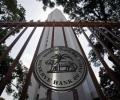
The RBI is understood to be dithering since it would want more clarity on the cost of the fiscal policies the new government would undertake before it decides to cut rates, even though it has pencilled in a lower gross domestic product growth rate for this fiscal year.

'The no-rate cut policy and preference to wait for the Budget and clarity on the fiscal front demonstrate RBI Governor Shaktikanta Das is maturing in his new role,' notes Tamal Bandyopadhyay.

Today, they can't meet even the piffling capital norm set by Mint Road - Rs 5 crore for partnerships and Rs 10 crore for public and private firms in this line of business. Bulk of the trades are put through e-platform offerings of Reuters, Bloomberg, JPMorgan, Barclays or Deutsche Bank. And they have the web-based FXall, FXconnect, Atriax, Hotspotfx and LavaFX for company.

Shaktikanta Das is a master of the finest balancing act who listens to all but takes his own decisions, discovers Tamal Bandyopadhyay.
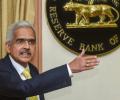
Central banking is a science, not an art, Tamal Bandyopadhyay tells RBI Governor Shaktikanta Das.

Rediff.com takes its readers through the various moods of Raghuram Rajan.

India has already termed as untenable the 'artificial enlargement' of the territorial claims by Nepal after its Parliament unanimously approved the new political map of the country featuring Lipulekh, Kalapani and Limpiyadhura areas which India maintains belongs to it.

FPIs are currently capped at 5 per cent of the total outstanding government dated securities, and own 4.5 per cent
Economic Affairs Secretary Subhash Garg is the finance ministry's primary liaison with the RBI.
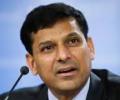
Rajan posed the question while speaking at the annual leadership conference in Mumbai National Association of Software and Services Companies.

This amount will include Rs 13,100 crore that Economic Affairs Secretary Subhash Garg has been publicly seeking from the central bank's contingency reserve fund since 2017-18 (FY18).

Senior bankers are trying to impress upon the central bank that the shift to external benchmark-linked lending be postponed to April 1, 2020.

The friction with the political class is not only about interest rates and monetary policy. While the government often spoke freely about its discomfiture, the RBI had to be careful even in its response to the government as any loose statement would affect the markets.

As the Reserve Bank maintained a status quo on key policy rates, analysts said higher demand due to supply constraints will not allow inflation to ease as quickly as anticipated and the apex bank may be forced to increase rates once more by the year-end.

She would be the first Indian to be occupying the coveted post at IMF after former RBI governor Raghuram Rajan

Unlike in the past, when old private banks compromised upon underwriting standards to take on the bulk, they've now realised that scaling up at the cost of quality isn't worth the while. These banks have also readjusted growth targets when required, and rebalanced books to preserve capital and asset quality.

North Block is concerned that when India is trying to attract more investment, putting up restrictions on audit firms could create an avoidable bad advertisement.

A section of the media on Thursday reported, quoting an unnamed EC official, that it may not allow RBI to go ahead with the plan before the polls and that they need more clarity from the Mint Road on certain aspects.

Private equity (PE) is set to play a bigger role in banks. Of 21 recommendations accepted by the Reserve Bank of India (RBI) out of 31 made by its Internal Working Group (IWG), its stance on non-promoter holdings in private banks is seen with excitement, though it doesn't refer to PEs explicitly. On non-promoter holdings in these banks, the RBI said this will be capped at 10 per cent of the paid-up voting equity share capital in the case "of natural persons and non-financial institutions and entities"; and "at 15 per cent for all categories of financial institutions, entities, supranational institutions, public sector undertaking, or the government." While this is a modification of the IWG's stance for the non-promoter holding in banks at up to 15 per cent, it does open up a huge window for PEs, all the same. This is because, while the RBI has remained silent on the eligibility of industrial houses for bank licences, fresh high-quality capital in large amounts can only come from PEs.
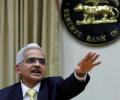
If the new governor can think out of the box even as he signals that he can bat for the RBI cadre and respect its institutional memory, that will go a long way in getting out of the current impasse.

The heartburn is over six sensitive issues

Piyush Goyal, who held the post of finance minister when Arun Jaitley was undergoing treatment, told the Confederation of Indian Industry's annual session: "All stakeholders, including the RBI, should introspect on their respective roles (on low economic growth)."

The RBI governor most famous oneliners -- 'I am Raghuram Rajan and I do what I do' -- that eventually summed up the year 2015 for the central bank

Governments that do not respect central banks' independence will sooner or later incur the wrath of the financial markets, ignite economic fires, and come to rue the day they undermined an important regulatory institution; their wiser counterparts who invest in central bank independence will enjoy lower costs of borrowing, the love of international investors, and longer life spans, said Acharya, who will return to the New York University's Stern Business School in August.

The reason, he said, was the external environment was weak.

2018 has been a disappointing and highly volatile year for equity investors.

Use of blockchain technology will ensure that banks will not be blindsided like in the case of the Nirav Modi-Mehul Choksi blowout at PNB, says Raghu Mohan.

After the Ukraine war, coke prices just soared and most units don't have money left to buy raw material. Customers are not absorbing the price escalation'

Jaitley has made it a habit of giving soundbytes to the media like his predecessors on why RBI should cut interest rates

Poor governance and mediocre short-sighted politics are destroying the paradise that Goa was as its environment, water table, culture and way of life is drastically threatened by tourism and migration, points out Ramesh Menon.

The shipping business is like the heaving sea -- it's up and down, observes Shyam G Menon.

Delivering a public speech hours after the RBI launched a rescue act for Yes Bank on March 6, Governor Shaktikanta Das reiterated the RBI's affirmation to do whatever was needed to combat the coronavirus impact. On that day, India had only one confirmed COVID-19 infection, the World Health Organisation was five days off from declaring it as a pandemic and the financially debilitating lockdowns were not even on the horizon. Das' promise on efforts to mitigate COVID-19 impact appeared as a footnote in news reports from the event.

'Nobody will wait now. Everyone will come to deposit their old notes. The confidence is shaken.'

The finance ministry and the RBI have performed many somersaults in these last 42 days.

For India, struggling for competitiveness, the current rupee overvaluation in terms of real effective exchange rate is a genuine constraint.
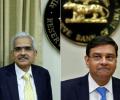
When did Urjit Patel really resign? When did Shaktikanta Das get the mandate to take over as RBI governor?
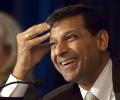
Former RBI Governor Subbarao blamed Chidambaram for undermining the autonomy of RBI and putting pressure on him to cut interest rates.

'We get to know secrets such as some of India's top-rated firms do not always make payments when due and many State-owned, listed, enterprises that borrow in bond markets default regularly.' 'Without naming the bank, he says that ever-greening of poor loans by a part of India's shadow banking lay at the doorstep of India's banking, notably 'one private bank'.' Viral Acharya's Quest for Restoring Financial Stability in India won't be music to many ears, observes Tamal Bandyopadhyay.
 © 2026 Rediff.com - Advertise with us - Disclaimer - Privacy Policy - Sitemap - Feedback - About us - Terms of use - Grievances